Does Islam promote violence?
The claim that Islam promotes violence is not a neutral one. It is an allegation—one that singles out Islam as uniquely dangerous. And the response is clear: Islam does not promote violence. It does not teach terrorism, the targeting of civilians, or the celebration of bloodshed.
The claim that Islam promotes violence is not a neutral one. It is an allegation—one that singles out Islam as uniquely dangerous. And the response is clear: Islam does not promote violence. It does not teach terrorism, the targeting of civilians, or the celebration of bloodshed.
Islam places a high moral value on human life, justice, and restraint. The Qur’an condemns unjust killing in the strongest terms, commands fairness even toward those one dislikes, and forbids aggression. It says: “Whoever kills an innocent person, it is as if they have slain all of humanity” (Qur’an 5:32). Echoing this emphasis on the sanctity of life, the Prophet Muhammad (peace be upon him) emphasized that faith is inseparable from respect for human life. A person can only remain morally sound in their faith so long as they do not unlawfully shed blood.
Islam represents a spiritual journey toward God, centered on worshipping Him alone and caring for His creation (Q 4:36). Muslims affirm mercy and compassion as fundamental characteristics of God (Q 1:1), His Prophet Muhammad (Q 21:107), and the faith itself.
The Qur’an repeatedly instructs believers to respond with peace in the face of hostility (Q 25:63, Q 41:34), act fairly even to those who have hatred and animosity toward you (Q 5:8), fight only against those who fight you (Q 2:190), and treat with compassion and justice those who do not (Q 60:8).
The Prophet Muhammad modeled forgiveness and compassion, even toward those who persecuted him and his followers. His example teaches Muslims to show compassion to all on earth.
At the same time, Islam, like the majority of the global population, recognizes the presence of conflict, and therefore allows for fighting in limited and specific circumstances. But even then, strict ethical boundaries apply and cruelty is never excused. [See “What is jihad?” for more.]
Engineering the enemy
Why, then, does the accusation that Islam promotes violence persist so powerfully? The answer lies in the casting of Islam as a civilizational threat—an ideology presumed to incline its followers toward violence by nature. When acts of violence are committed by Muslims, they are labeled “Islamic terrorism,” whereas similar acts of violence by others are framed as mental health crises, lone wolf incidents, or just tragic events. This framing turns Islam itself into the “cause” of violence, implying that Muslims are inherently dangerous.
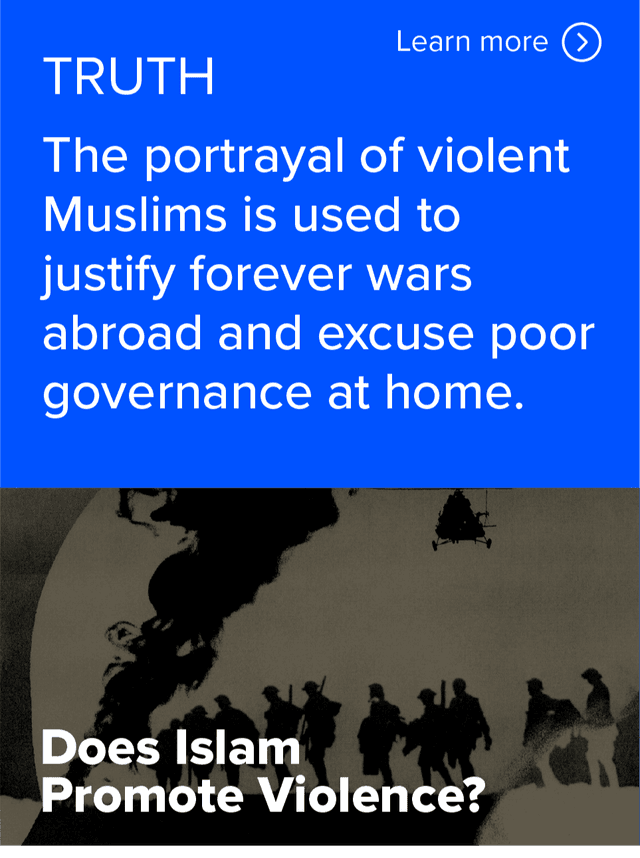
This asymmetry matters. It trains the public to treat Islam as the cause of behavior rather than a label used by the perpetrator. And once Islam is treated in this way, a new logic follows: If Islam is the cause, then Muslims become the threat. This misrepresentation has real consequences. It shapes laws, media coverage, and foreign policy. Muslim communities are subject to mass surveillance, restrictions on religious practice, and erosion of civil liberties in the name of safety. It has provided moral cover for wars, occupations, and collective punishment in Muslim-majority countries, where civilian deaths are often dismissed as tragic but necessary responses to an alleged religious threat.
Extremist groups like ISIS are frequently treated as the logical outcome of Islam taken “seriously,” when in reality they are political movements that deliberately manipulate religious language while violating Islam’s core moral principles. Accepting their self-description at face value erases the difference between a global faith of nearly two billion people and criminal organizations built on coercion, fear, and spectacle. This collapse shifts attention away from the political conditions that give rise to violent movements (war, occupation, repression, trauma) and places the blame on religion instead. It also perpetuates a permanent state of suspicion toward Muslims, who are then expected to continuously disavow violence in order to be granted conditional acceptance.
Fixating on Islam as the alleged cause of violence obscures the real dynamics through which violent movements emerge: political instability, sustained injustice, dehumanizing propaganda, and the strategic use of identity to mobilize anger. By reducing complex conflicts to a religious caricature, the public narrative offers a simple enemy. Terrorism is a political phenomenon that borrows whatever language it needs—religious or secular—to recruit and justify harm.
As long as the claim that Muslims are uniquely violent remains unchallenged, efforts to address violence will continue to fail because they are built on a false diagnosis. Justice and security cannot be achieved by scapegoating a faith; they require confronting the structures that make violent movements possible in the first place.
In short, Islam itself does not promote violence. Misunderstanding and misrepresenting it have allowed fear and suspicion to thrive, with real-world consequences for Muslims and the wider world. Separating fact from false narratives is essential for justice, security, and peace.
For more, see: Dr. Nazir Khan, “Is Islam a Violent Religion? Debunking the Myth,” Yaqeen Institute for Islamic Research, November 16, 2016